

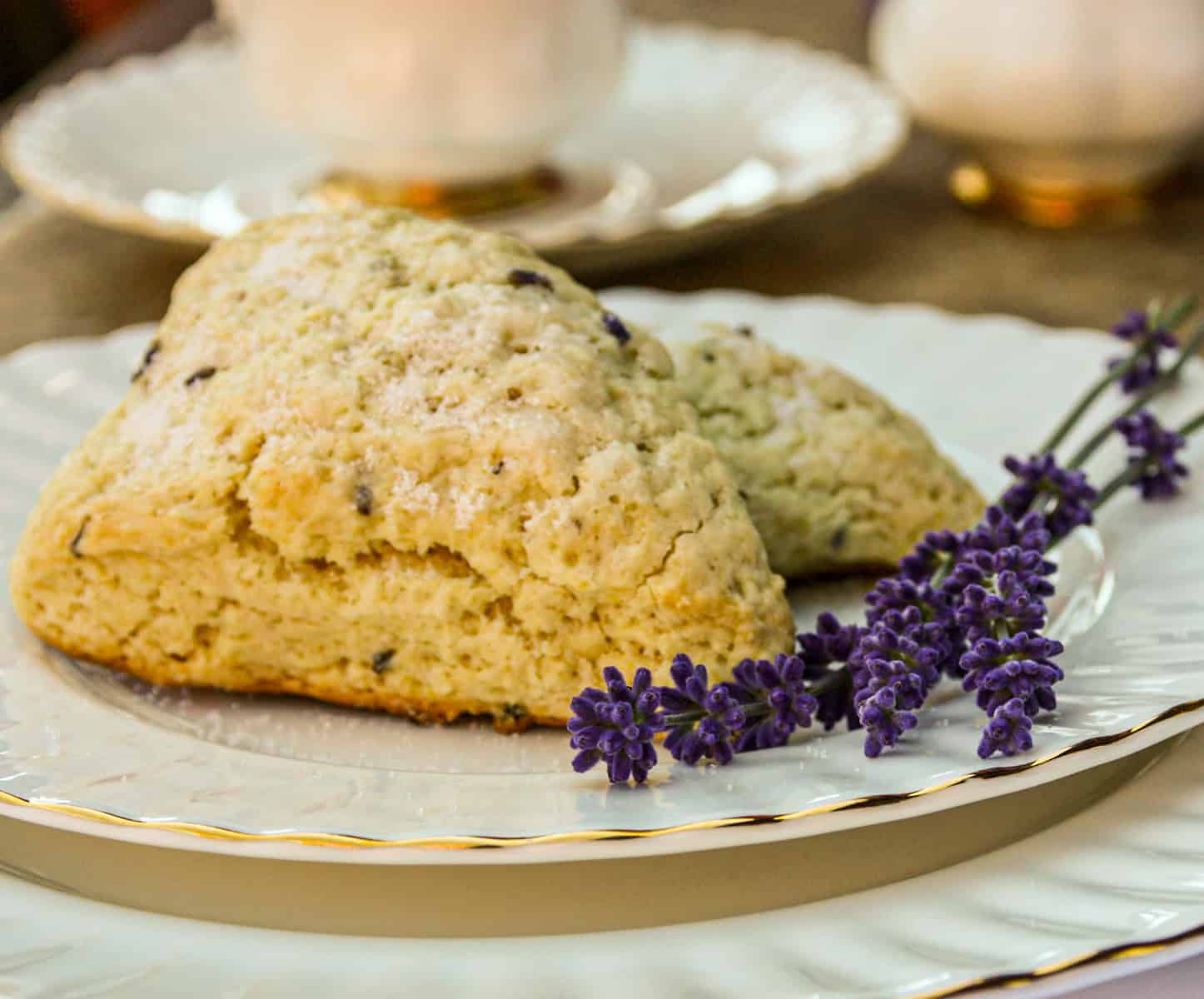
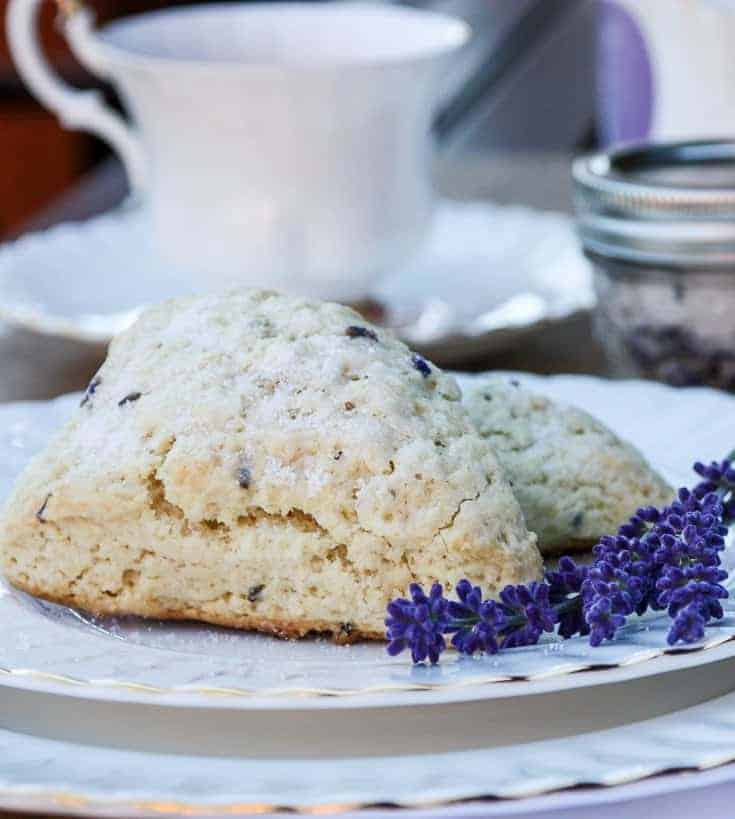
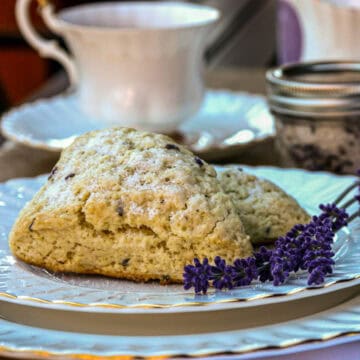
Lavender scones bring a touch of elegance to your next weekend brunch or afternoon tea. If you've never baked with floral flavors before, don't worry-there is no "soapy" aftertaste here! Instead, the subtle, floral flavor of lavender buds pair beautifully with a touch of lemon to create a scone that is buttery, flaky, and uniquely delicious.
Want to save this recipe?
Enter your email & I'll send it to your inbox. Plus, get great new recipes from me every week!
If you fall in love with the flavor, you can even use your leftover buds to make a simple syrup for lavender lemonade or bake up a stunning lemon lavender cake next!
This recipe was originally published in 2014. Which was before I was diagnosed with Celiac. I've now tested the recipe with different gluten-free flour blends, (I'll talk about those in the Ingredients section below), and can tell you with confidence that you can make these lavender scones gluten-free. Or, you can make them with regular all-purpose flour, like the original.
Jump to:
Ingredient Notes
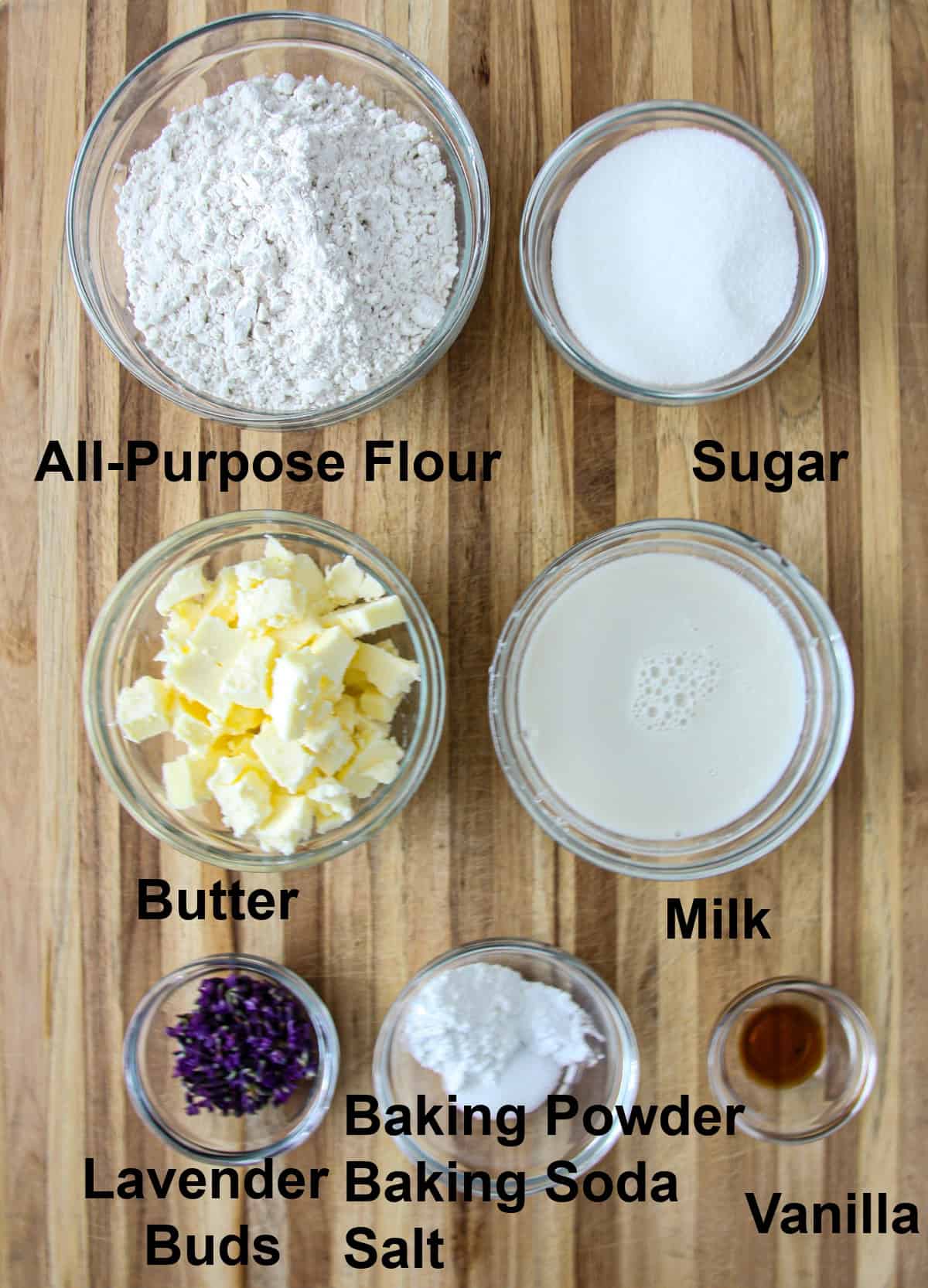
- Flour. For this recipe, I use a gluten-free, measure for measure (1:1) all-purpose flour blend. I tested the recipe with almond flour, and found the scones a bit heavy and dense. Rice flour worked the opposite way, and my scones were too dry and crumbly. After deciding on a blend, I have tested this recipe using both Bob's Red Mill 1 to 1, and Cup4Cup. Both were a success and I would recommend either. If you use a different blend, be sure that it contains xanthan gum. (Also, see my tips below about measuring gluten-free flour). Use regular all-purpose flour if gluten isn't a concern.
- Sugar. Regular white sugar works best. Its neutral taste doesn't overpower the subtle lavender flavor.
- Lavender. Many recipes call for culinary lavender. The truth is, lavender is a herb, and all lavender is edible. The difference is in how it is processed. I'm using fresh lavender from my garden, because I know that it hasn't been sprayed with any herbicides or pesticides. If you have garden lavender you can safely use it for culinary use. English lavender is preferred over French lavender for its color and flavor. Just give the lavender sprigs a good rinse under cold water in case there are any little bugs hiding. Otherwise, be sure to buy dried lavender that's labeled as culinary, or food grade lavender. You can buy it online or at specialty stores.
- Butter. I use unsalted butter for baking. But if I don't have it on hand, I will use salted butter, and just eliminate the added salt in the recipe.
- Milk. Use any milk, including dairy milk, for this recipe. I use almond milk.
- You will also need fresh lemon juice, pure vanilla extract, baking powder, baking soda, and salt.
How to make it, step by step
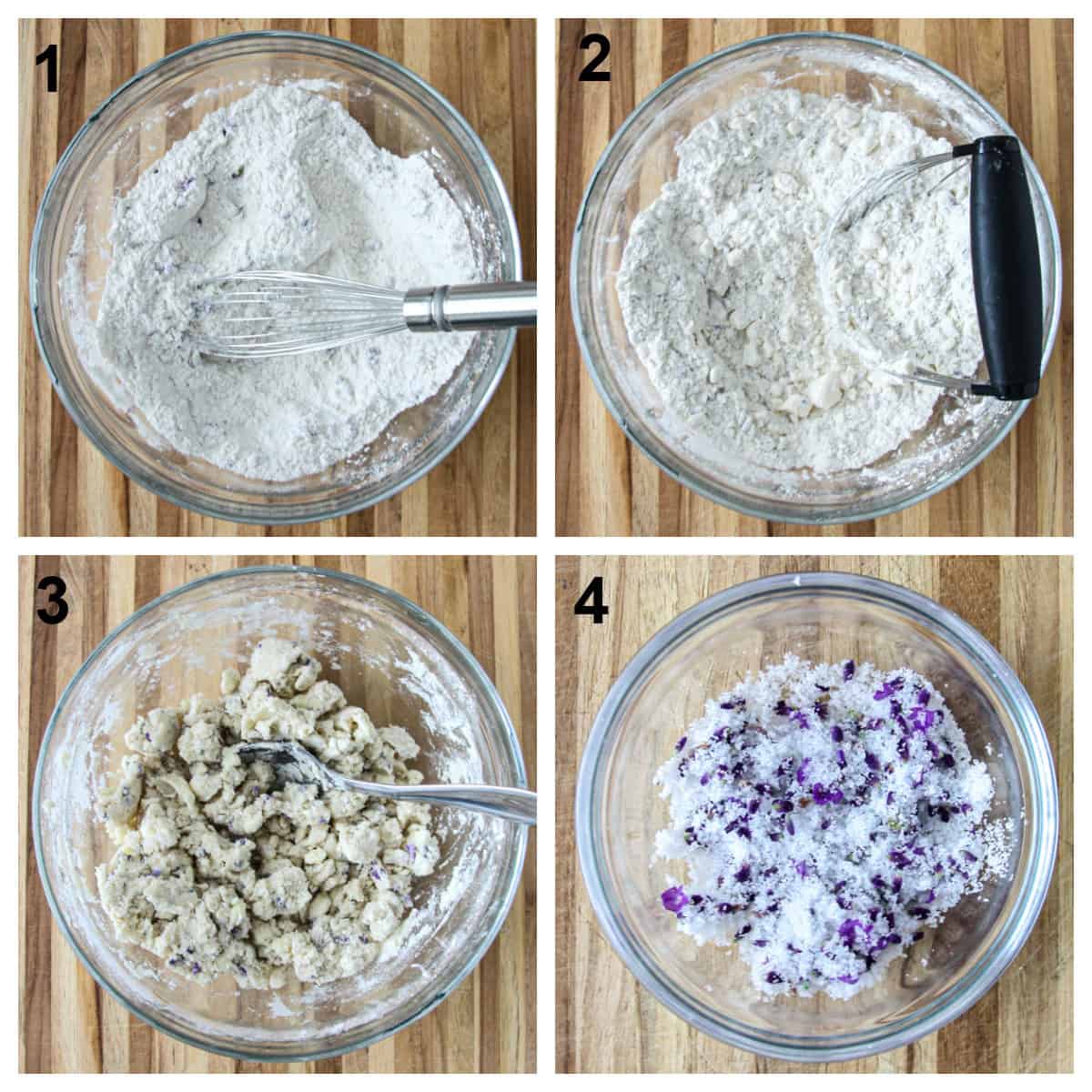
- In a large mixing bowl, whisk together the flour, sugar, lavender buds, baking powder, baking soda, and salt.
- Use a pastry cutter to cut the cold butter into the flour mixture, until it resembles course crumbs.
- Stir the lemon juice and vanilla extract into the milk. Add the milk mixture to the dry ingredients and gently mix until just combined.
- In a small bowl, combine reserved lavender buds and sugar, rubbing to release the fragrant lavender oil.
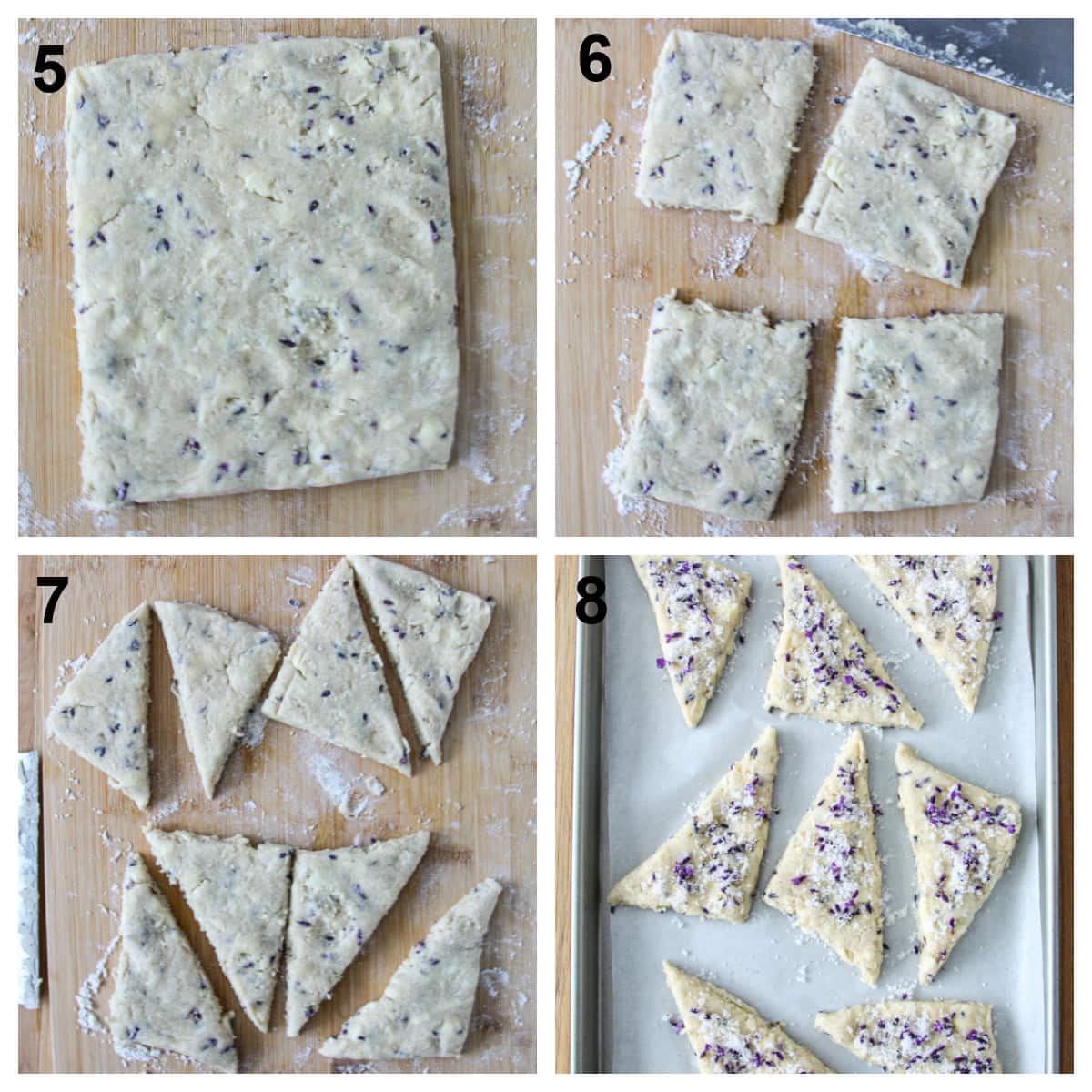
- Turn the shaggy dough onto a lightly floured surface, kneading quickly until it comes together. Shape into a rectangle. (You can trim the edges if you like a less rustic look.)
- Cut the rectangle in half horizontally, then cut each half into squares.
- Cut each square in half diagonally to form 8 triangles.
- Place the triangles on a parchment-lined baking sheet and sprinkle the lavender sugar on the tops of the scones.
- Bake for 15 minutes, then cool on a wire rack.
My top tips for fluffy, tender scones
- Use cold ingredients. The key to flaky, high rising scones is having little pockets of butter throughout the dough, so we want to avoid having the butter soften. Keep the butter and milk in the fridge until just before using them. I recommend cutting the cold butter into small cubes as a first step, and returning it to the fridge until it's time to use it. You can also freeze your butter and grate it with a box grater. If your oven makes your kitchen very warm, don't preheat it until you have finished forming your scones. Put the baking sheet in the fridge to wait for the oven to preheat.
- Don't overmix. If you're using regular flour, use a gentle touch and work quickly. This keeps the mixture from forming excess gluten, resulting in tough, dense scones. If you're using gluten-free flour, the same rule applies, for a different reason. Over mixing gluten free flour causes the starches to break down, also resulting in a dense, gummy scone.
Notes about measuring gluten-free flour
It's important to use the right measuring cups. If you use a liquid measuring cup to measure dry ingredients like flour, you won't have a accurate measurement because the flour will pack. You'll end up with too much flour, which results in crumbly cookies.
Use nesting measuring cups for dry ingredients. The best way to measure will always be by weight, but since most home cooks use measuring cups, and most recipes are written that way.
For measuring gluten-free flour, use the spoon and level method for more accuracy. Put your measuring cup on a paper towel. Use a spoon to fill the measuring cup with flour until it's a little over filled. Then use the back of a butter knife to level it. The excess flour will land on the paper towel and you can scoop it back into the bag.
Want More Scones?
Try Blueberry Scones or Earl Grey Scones
Did you make this recipe? Please leave a rating in the comments below and let us know how it turned out. Did you make any changes? We would love for you to share and your feedback is important! Thank you for visiting The Food Blog!
Recipe
Want to save this recipe?
Enter your email & I'll send it to your inbox. Plus, get great new recipes from me every week!
Lavender Scones
Ingredients
- 1 ½ cups all-purpose flour Gluten-free if needed
- ½ cup sugar plus one tablespoon
- 3 tablespoon fresh lavender buds, divided or 2 teaspoon dried lavender buds
- 2 ½ teaspoon baking powder
- ½ teaspoon salt
- ¼ teaspoon baking soda
- ⅓ cup cold butter cut into small cubes
- ½ cup milk
- 1 tablespoon lemon juice
- ½ teaspoon vanilla extract
Instructions
- Preheat oven to 425 degrees.
- Line a large baking sheet with parchment paper.
- In a large bowl, whisk together flour, sugar, 2 tablespoons of lavender buds, baking powder, salt, and baking soda.
- Using a pastry blender, combine butter with dry ingredients until it resembles coarse crumbs.
- Stir the lemon juice and vanilla into the milk.
- Add milk to dry ingredients and combine.
- In a small bowl, mix one tablespoon of sugar and one tablespoon of lavender buds.
- Turn dough onto a lightly floured surface and knead quickly until dough takes shape.
- Pat dough into a rectangle shape, about one inch thick.
- Cut the rectangle lengthwise and then each rectangle in half. Cut each piece diagonally in half so that you end up with eight triangles.
- Transfer to prepared baking sheet. Sprinkle the tops of the scones with the lavender sugar.
- Bake for 15 minutes until golden brown.
- Cool on a wire rack.
Notes
- Use cold ingredients. The key to flaky, high rising scones is having little pockets of butter throughout the dough, so we want to avoid having the butter soften. Keep the butter and milk in the fridge until just before using them. I recommend cutting the cold butter into small cubes as a first step, and returning it to the fridge until it's time to use it. You can also freeze your butter and grate it with a box grater. If your oven makes your kitchen very warm, don't preheat it until you have finished forming your scones. Put the baking sheet in the fridge to wait for the oven to preheat.
- Don't overmix. If you're using regular flour, use a gentle touch and work quickly. This keeps the mixture from forming excess gluten, resulting in tough, dense scones. If you're using gluten-free flour, the same rule applies, for a different reason. Over mixing gluten free flour causes the starches to break down, also resulting in a dense, gummy scone.


Miranda Gray says
Love these scones! I've been making them for years. I noticed you recently updated the recipe. Would you be able to share with me the adjustments you made?
Thank you for the help!
M
Colleen Milne says
Hi Miranda. I'm so happy that you love the scones. Thanks for this question. Yes, I recently updated the post, but the recipe is the same. The only changes I made were: Using 3 tablespoons of fresh lavender OR 2 tsp dried lavender. (The original only had measurements for dried.) And, instead of buttermilk or substitute, I tweaked it to use milk and lemon juice, (which was the substitute). This is because I felt the lemon juice added that extra lemon flavor. However, feel free to continue using buttermilk! Hope this helps. Happy baking!
Miranda Gray says
Thank you!! I thought so but I just wanted to double check
Monica says
Do you bake the lavender buds into the sones? It looks like that in the picture? Or do you just sprinkle them on top with the sugar?
Or do both?
Colleen says
Hi Monica, yes, both, as per the recipe instructions. These scones are delicious, enjoy!
Shea P says
Scrumptious scones, and really easy to make! Thanks!!
Colleen says
They really are scrumptious and easy to make. Thanks for letting me know, Shea!
Maggie says
These scones are literally to die for... I made this recipe and it wasn’t hard at all!! Would definitely recommend Colleen and her recipes! Always delicious.
Sarah C says
These scones are perfection. They're buttery, delicious and surprisingly simple and easy to make.
Colleen says
Hi Sarah! I'm so happy that these scones turned out so well for you!
MJM says
Hi. Thanks for your recipe.
Is it 1.5 Tablespoon of baking powder or 1.5 teaspoons?
Colleen says
Hi MJM, You're welcome. 1.5 tbsp is correct. Enjoy your scone making!
JC says
The first batch I tried exactly following the directions. They were very overcooked - too dark and dry. The second batch I dropped the temperature to 400 and cooked for 13 minutes. Much better color and texture.
Colleen says
Hi JC. Unfortunately, oven temperatures can vary greatly, and I can only go with my own when writing a recipe. As you can see by my photos, the scones turned out perfectly for me at 425° for 15 minutes. I'm so happy that your 2nd attempt turned out well for you, though. Enjoy!
Shauna | Linden & Lavender says
What a lovely post!! Just found your blog 🙂
Colleen says
Thanks so much, Shauna! So glad that you found it, and I hope you come back often! 🙂
Megan says
When using lavender sugar, how do I convert the sugar and lavender listed in a recipe?
Colleen says
Hi Megan, Simply use the same quantity of lavender sugar as sugar in the recipe, and leave out the lavender, which is what I did with these scones. Good luck with the recipe, and I would love to hear how it turned out for you! 🙂
Megan says
I failed! I mixed up baking powder and soda when I was. Measuring. The burned, with 5 min left in the cooking time and had a chemical after taste. To tired to try again today, but I will soon!
Colleen says
Megan, so sorry to hear that! Don't feel bad, though; we've all had our kitchen failures. Watch the baking time next time, as the recipe is only a guideline. Oven temperatures can vary and altitude is sometimes a factor. So I would set your timer for 10 minutes early just to check. Good luck next try! 🙂
Amelia says
I've made this recipe twice now. Easy to make vegan with vegan butter and almond milk. Love it!
My oven cooked them well at 425 for 18 minutes for mini scones and 20 for the full size 8 discribed above. 💕. Thank you!
Colleen says
Hi Amelia,
I'm so happy that these scones turned out well for you both times. I love the mini scone idea, definitely going to give that a try! Also, thank you so much for sharing about making a vegan version, which I know will be super helpful to my vegan readers.
Cheers and Happy Baking!
Nicoletta @sugarlovespices says
I love the look of your scones, which seem to be buttery and flaky/crumbly and not -the word I use more often to describe the majority of them- "cakey". I happen to love scones, really really love them but cannot stand the ones that taste like a piece of moist cake. Hence, I am going to try yours, I have culinary grade lavender (lavender sugar as well) and a want for some good scones. Thank you! 🙂 P.s. Congratulations on your daughter wedding and for making it d.i.y.!
Colleen says
Nicoletta, thank you and I agree about the "cakey" scones. I like them to be light and crumbly like a true scone. I hope you do try these, and thanks for the congrats. This post is a couple of years old, and now I have a one month old baby grandaughter!
Elaine @ Flavour and Savour says
So pretty! Culinary lavender has such a delicate flavour and I imagine it would be fabulous in these scones. I must try that sugar scrub. I have about 30 large lavender plants that I just let the bees enjoy. Time to put it to other uses, too!
Colleen says
Thanks Elaine. The bees do love the lavender, don't they?
Gabrielle @ eyecandypopper says
Lovely scones! I've never baked with lavender, but this would be a good way to start. It would taste great with honey!
Colleen says
Thanks Gabby! Yes they are perfect with honey. 🙂
Dina says
Colleen, is this a new look for your blog? Looks great, new or not. You don't look old enough to have a married daughter. Must be your food....
Everything looks so appetizing and inspiring.